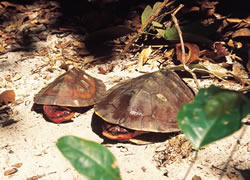
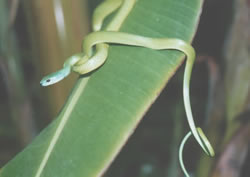
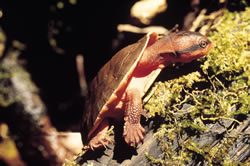
PARQUE NACIONAL DO VIRUÁ
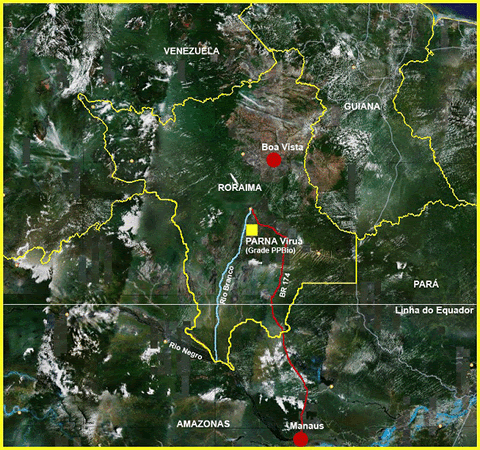
General info: The Viruá National Park includes more than 227,000 ha and is located in the Municipality of Caracaraí (RR). The name derives from a stream that rises withing the park. The climate is equatorial (hot and humid), with a short dry season, with higher rainfall in the autumn. The area includes a large almost flat plain, with a predominance of poorly drained soils, with a large quantity of lakes. Towards the north, there are low residual hills. O the western side, delimited by the Rio Branco, there are alluvial flood-plains, which also occur in the South, along the River Anauá. Note that because of its location in the Northern hemisphere Viruá field station will be the only one (within the offered excurssions) in the rainy season, which coincides with reproductive period of many anuran species.
Vacancies: min. = 20 person, and max. = 25 person.
How much: US$ 200,00. To be paid in Manaus.
Available schedules: 12th – 16th August / 23th - 26th August.
How you'll get there: Overnight bus from Manaus bus station (Rodoviária de
Manaus). You will leave Manaus on the 19:00 (7 p.m.) bus, and arrive at Viruá about 06:00 (6 a.m.) the following morning. Be prepared to sleep on the bus.
Where you will sleep: Hammocks in rustic huts. For people that are unable to
sleep in hammocks, we may be able to arrange a limited number of beds. If you
have special requirements, contact us before hand.
Planned activities: Local guides (graduate students) will accompany the trip.
However, this site is a part of the Program for Biodiversity Studies
(PPBio –http://ppbio.inpa.gov.br) that has installed RAPELD grids in numerous sites
throughout Brazil (see web site for details). Participants can undertake self-guided
tours on the 60km of marked trails in the system. However, removal of organisms
from the reserve is not permitted.
What you should bring: Hammock, rope (2 pieces of 1 m), mosquito net for
hammock, sleeping-bag, plastic boots, sunscreen, hat, long pants and long-sleeves
for walking across the savannas, insect repellent.
For further information: Luciana Erdtmann (luciana.erdtmann@gmail.com)
Ricardo Romero (ecoromero@gmail.com)

|